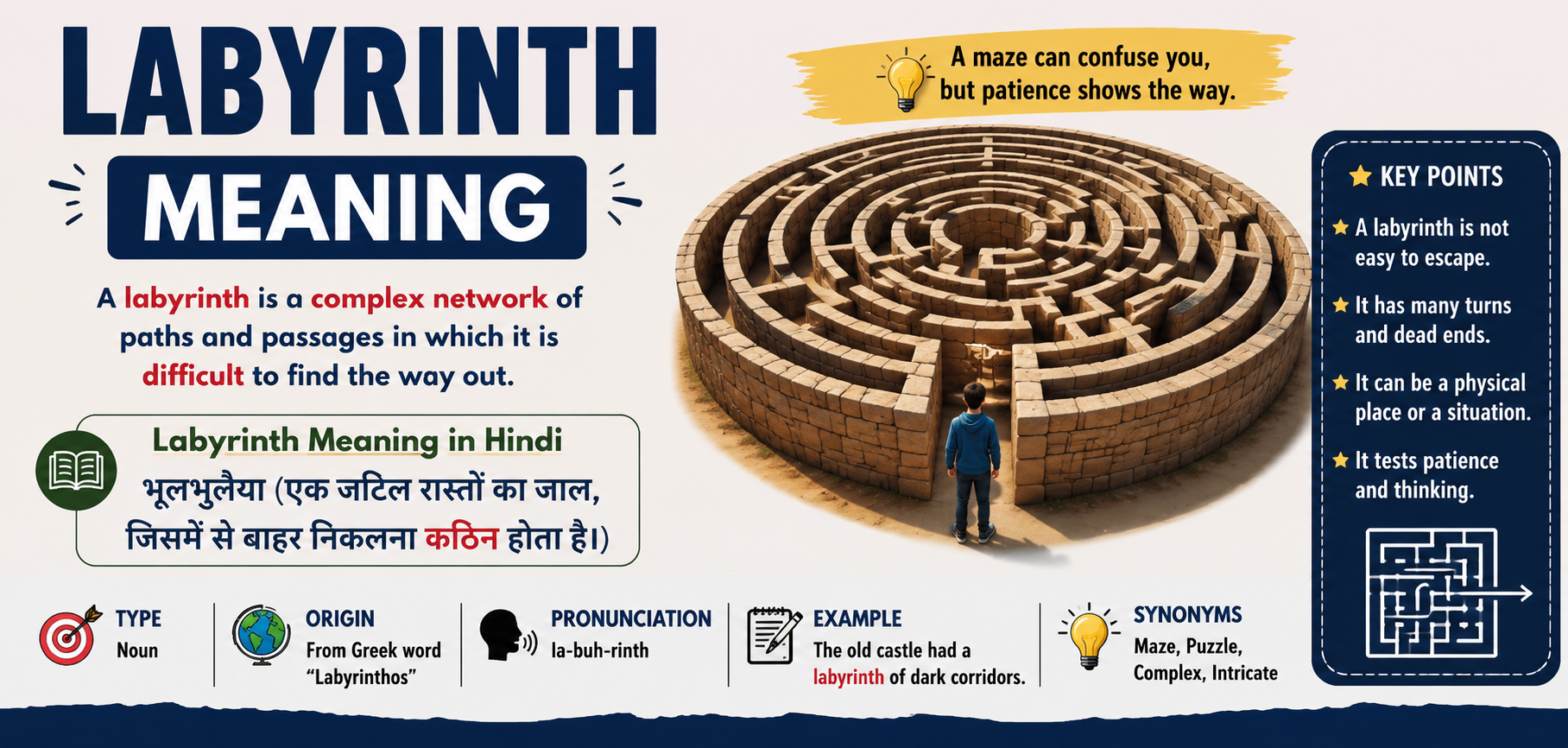
A labyrinth is one of those words that sounds as tricky as its meaning. It describes a place full of twisting, winding paths where you can easily get lost. Many students come across this word in stories, myths, and even science books. Once you know the labyrinth meaning, you will spot it everywhere.
This word is older than most people think, and it has a rich history. It is used in English, and students often search for labyrinth meaning in Hindi as well. Both meanings are covered here, in simple, clear English.
Quick Stats Table
| Point | Detail |
|---|---|
| Word / Term | Labyrinth |
| Part of Speech | Noun |
| Meaning | A complex maze of paths or passages; a very confusing system or situation |
| Definition | A place with many twisting paths where it is very hard to find the way out |
| Origin / Language | Greek: labyrinthos |
| Pronunciation | LAB-uh-rinth |
| Synonyms | Maze, puzzle, tangle, warren |
| Antonyms | Straight path, order, clarity |
| Example Sentence | The old castle had a labyrinth of underground tunnels beneath it. |
| Category | Word Meaning |
Definition of Labyrinth
The labyrinth meaning in its simplest form is this:
A labyrinth is a complicated network of paths, passages, or tunnels in which it is very easy to get lost.
It can also mean any situation, system, or place that is very complex and confusing. A school might call its new rules “a labyrinth of policies.” A city map full of tiny roads can look like a labyrinth.
The word can describe a physical place or an idea. Both uses are correct.
Labyrinth Meaning in English
Labyrinth meaning in English covers two connected ideas.
1. A physical labyrinth: This is a real place, like a maze in a garden or a cave system with many passages. You walk in, and the paths twist and turn. It is very hard to get out without help.
2. A figurative labyrinth: This is when something is so complex and confusing that it feels like a maze. For example, filling in lots of forms to get a passport can feel like a labyrinth of paperwork.
Both meanings are widely used in English today.
Labyrinth Meaning in Hindi
Labyrinth meaning in Hindi is:
भूलभुलैया (Bhoolbhulaiya)
यह एक ऐसी जगह है जहाँ बहुत सारे घुमावदार रास्ते होते हैं और बाहर निकलना बहुत मुश्किल होता है।
In English: A labyrinth in Hindi is called भूलभुलैया (Bhoolbhulaiya). This Hindi word is used for a maze or a confusing network of paths. Many students search for labyrinth meaning in Hindi when they come across this word in their English lessons.
The Hindi word भूलभुलैया perfectly captures the idea of a place where you forget the way and feel puzzled.
Pronunciation of Labyrinth
Labyrinth is pronounced as:
LAB-uh-rinth
Break it into three parts:
- LAB (sounds like the word “lab,” as in science lab)
- uh (a short, soft sound)
- rinth (sounds like “rinth,” rhymes with “plinth”)
So say it slowly: LAB – uh – rinth.
Practice it a few times and it will feel natural very quickly.
Part of Speech
Labyrinth is a noun.
It names a thing, a place, or an idea.
| Form | Example |
|---|---|
| Noun (singular) | The labyrinth was very dark. |
| Noun (plural) | The caves formed two separate labyrinths. |
| Adjective form | The path was labyrinthine (very complex). |
The adjective form, labyrinthine, is used to describe something that is as complicated as a labyrinth.
Explanation
What Does Labyrinth Mean?
Labyrinth meaning tells us about a place or situation that is hard to move through because of its many twists, turns, and choices.
Think of it this way. You walk into a huge garden. There are many paths. Every path splits into two more paths. Some paths lead to dead ends. You cannot see over the walls. You do not know which way to go.
That garden is a labyrinth.
Now think of a different example. A student needs to apply for a school competition. She has to fill in Form A, then get it signed, then fill in Form B, then send an email, then wait for a code, then fill in Form C. The process is so confusing that she feels totally lost.
That process is also a labyrinth, but of a different kind.
Two Main Ways to Use the Word
Physical meaning: A real place, like a maze of tunnels, corridors, or garden paths, where getting lost is easy.
Figurative meaning: Any system, situation, or collection of rules that is very hard to follow or move through.
Both uses are fully correct in English.
Why Is This Word Important?
Students in Class 5 and Class 6 often read stories that use this word. It appears in myths, adventure stories, mystery novels, and even science texts about the inner ear. Yes, the inner ear of the human body has a part called the labyrinth because of its twisting shape.
Knowing the labyrinth meaning helps you read better, write better, and understand the world more clearly.
Examples of Labyrinth (Numbered List)
Here are twenty examples of the word labyrinth used correctly.
- The old palace was full of rooms and halls that formed a labyrinth.
- Visitors to the corn maze said it felt like a real labyrinth.
- The underground caves were a labyrinth of dark tunnels.
- The hero in the story had to pass through a labyrinth to reach the treasure.
- The city’s old streets were a labyrinth with no clear direction.
- His thoughts were a labyrinth that he could not sort out.
- The new tax rules felt like a labyrinth of confusing instructions.
- She walked into the market and found herself in a labyrinth of small shops.
- The hospital corridors were a labyrinth, and he could not find the right ward.
- The child drew a labyrinth on paper and asked her brother to solve it.
- In mythology, the Minotaur lived at the centre of a great labyrinth.
- The library’s old section was a labyrinth of wooden shelves and narrow aisles.
- The legal system can sometimes feel like a labyrinth for ordinary people.
- He entered a labyrinth of narrow alleys and soon had no idea where he was.
- The teacher said that grammar rules are not a labyrinth if you study them step by step.
- The underground station had a labyrinth of tunnels and platforms.
- The paperwork needed for the visa was a labyrinth of forms and stamps.
- The roots of the old tree had grown into a labyrinth under the ground.
- The spy had to move through a labyrinth of secret passages to reach the vault.
- The doctor explained that the inner ear contains a small labyrinth of fluid-filled canals.
Sentence Examples
Here are short, clear sentences using labyrinth in everyday situations.
- “The cave system was a labyrinth stretching for miles.”
- “We spent an hour lost in the labyrinth of narrow streets.”
- “The rules of the game were a total labyrinth.”
- “A labyrinth in mythology was a place of mystery and danger.”
- “She found the hospital a labyrinth of corridors and waiting rooms.”
- “The scientist said the cochlea is a labyrinth inside the human ear.”
- “The children laughed as they ran through the garden labyrinth.”
Real-Life Examples
1. The Alnwick Garden Labyrinth (United Kingdom)
One of the most famous real labyrinths in the world is in Alnwick Garden in England. It is made of tall hedges. Thousands of visitors try to find the centre and then find their way out every year.
2. The Human Ear
The inner ear is called a labyrinth by doctors. It has a bony outer part called the osseous labyrinth and a soft inner part called the membranous labyrinth. Its twisting, coiled shape gave it the name. (Please verify with a standard biology or anatomy textbook.)
3. Mythology
In the ancient Greek myth, King Minos of Crete had a labyrinth built. The craftsman Daedalus designed it. The monster Minotaur lived at its heart. This is one of the most famous stories connected to the labyrinth meaning.
Common Mistakes
Students sometimes confuse or misuse this word. Here are the most common errors and the correct forms.
| Mistake | Wrong | Right |
|---|---|---|
| Spelling error | labrynth | labyrinth |
| Spelling error | laberynth | labyrinth |
| Wrong use as a verb | He labyrinthed through the halls. | He moved through the labyrinth of halls. |
| Mixing it with “maze” | A maze and a labyrinth are never the same. | They are similar but have differences (see comparison table). |
| Plural form error | Two labyrinth | Two labyrinths |
Tip: The trickiest part of spelling labyrinth is the middle. Remember: LAB + Y + RINTH. The letter Y sits right in the middle.
Tips to Remember
Here are simple tips to keep the labyrinth meaning in your memory.
- Picture a maze. Every time you see the word labyrinth, picture a garden maze or a cave with many passages. That image will lock the meaning in.
- Link it to the story. Think of the Minotaur’s maze. The word labyrinth and that myth are connected for thousands of years.
- Spell it in parts. Say it as three blocks: LAB + Y + RINTH. It will never confuse you again.
- Use it in a sentence today. Write one sentence with the word labyrinth in your notebook. Using a word once helps you keep it.
- Think of the Hindi word. Labyrinth meaning in Hindi is भूलभुलैया. Both words feel just as twisty as the paths they describe.
- Remember the body connection. The inner ear is also a labyrinth. Science and English meet in this one word.
Synonyms of Labyrinth
These words have a meaning very close to labyrinth. Each one is listed with a short meaning so you know when to use it.
| Synonym | Short Meaning |
|---|---|
| Maze | A network of paths with many dead ends |
| Tangle | A twisted, confused mass of things |
| Warren | A series of connected passages, like rabbit tunnels |
| Puzzle | Something hard to work out or move through |
| Web | A complex arrangement of connected things |
| Muddle | A state of confusion and disorder |
| Complexity | The state of being made of many connected parts |
| Coil | A winding, spiral arrangement |
Antonyms of Labyrinth
These words are opposite in meaning to labyrinth.
| Antonym | Short Meaning |
|---|---|
| Straight path | A clear, direct route |
| Order | A neat, well-arranged system |
| Clarity | Something easy to follow and understand |
| Simplicity | The quality of being easy and uncomplicated |
| Corridor | A single, clear hallway or passage |
Similar or Confusing Words
Labyrinth vs Maze
Many people use these two words as if they are exactly the same. They are very close in meaning, but there is a small difference that is worth knowing.
| Point | Labyrinth | Maze |
|---|---|---|
| Number of paths | Often one winding path that leads to the centre | Many paths, many dead ends |
| Dead ends | Usually very few | Many dead ends on purpose |
| Goal | Walk to the centre and come back | Find the exit, avoid dead ends |
| Feeling | Meditative, purposeful | Puzzling, competitive |
| Usage | Both physical and figurative | Mostly physical |
In everyday English, most people use labyrinth and maze to mean the same thing. In technical or specialist writing, the difference above may matter.
Labyrinthine
Labyrinthine is the adjective form. It means “as complicated as a labyrinth.”
Example: “The rules of the game were labyrinthine and hard to follow.”
Comparison Table
| Feature | Labyrinth | Maze |
|---|---|---|
| Origin | Greek labyrinthos | Old French mazer |
| Structure | One long winding path | Many branching paths |
| Dead ends | Few | Many |
| Goal | Reach centre and return | Find the exit |
| Used figuratively? | Yes, very common | Yes, also common |
| Example | “A labyrinth of rules” | “A maze of corridors” |
Conclusion
The labyrinth meaning is not as tricky as it sounds. A labyrinth is a maze-like place or a very confusing situation. The word came from the Ancient Greeks and has stayed in English for thousands of years. Knowing the labyrinth meaning in Hindi as भूलभुलैया helps Hindi-speaking students connect the English word to something they already know.
Whether you see the word in a story, a science book, or an everyday sentence, you now have everything you need to use and understand labyrinth with full confidence.
Read More:
Frequently Asked Questions
1. What is the labyrinth meaning in simple English?
A labyrinth is a place or situation with many twisting, complicated paths. It is very hard to move through or get out of a labyrinth. It can be a real place, like a maze, or a situation, like a confusing set of rules.
2. What is the labyrinth meaning in Hindi?
Labyrinth meaning in Hindi is भूलभुलैया (Bhoolbhulaiya). It means a place where many confusing paths make it very hard to find the way out. This Hindi word is used for both garden mazes and confusing situations.
3. Where does the word labyrinth come from?
The word labyrinth comes from the Ancient Greek word labyrinthos. It was first used to describe the famous maze in the Greek myth of the Minotaur. The word later passed into Latin and then into English.
4. Is labyrinth the same as a maze?
A labyrinth and a maze are very similar, but not exactly the same. A labyrinth usually has one winding path that leads to the centre and back. A maze has many paths with dead ends and choices. In everyday English, both words are often used to mean the same thing.
5. How do you pronounce labyrinth?
Labyrinth is pronounced as LAB-uh-rinth. Say it in three parts: LAB, then uh, then rinth. It rhymes with “plinth” at the end.
6. What is the adjective form of labyrinth?
The adjective form of labyrinth is labyrinthine. It means very complex and twisting, like a labyrinth. Example: “The tax form had labyrinthine instructions.”
7. Can labyrinth be used to describe a situation, not a place?
Yes. Labyrinth is often used to describe any situation that is very confusing and hard to move through. For example: “The application process was a labyrinth of steps and requirements.”
8. Is labyrinth used in science?
Yes. In biology and medicine, the labyrinth is a part of the inner ear. It is a system of fluid-filled canals that helps with hearing and balance. The winding shape of this part gave it the name labyrinth.
Thank you for reading this word meaning page with us. For more fun word meanings, Visit At : Grammarfortune
