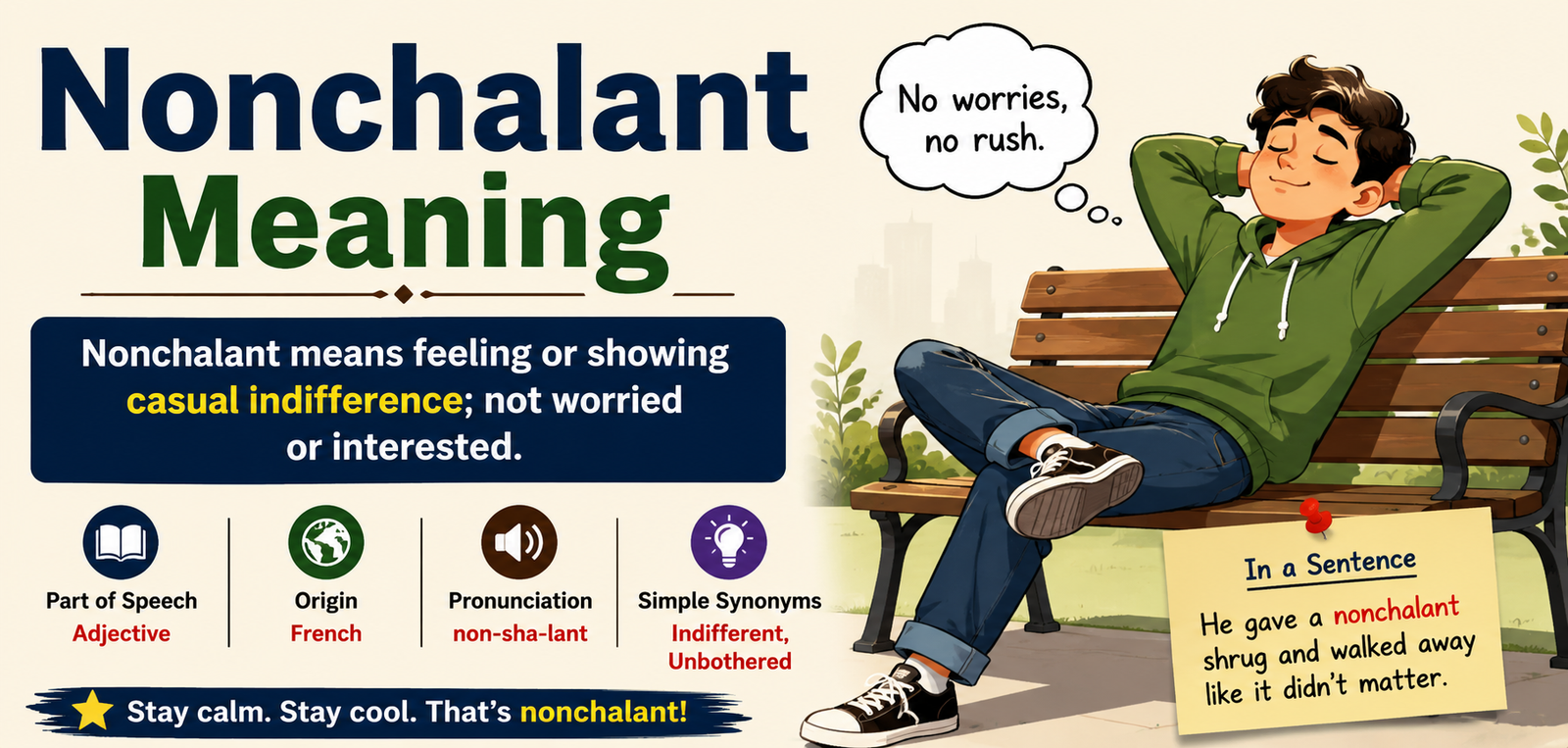
Welcome! Today we are talking about a very interesting English word. The word is nonchalant. Many students hear this word and feel confused. But do not worry. By the time you finish reading, you will know exactly what nonchalant meaning is. You will also know how to say it, how to use it, and what it means in Tamil, Hindi, and many other languages. Let’s get started!
Quick Stats Table
| Point | Detail |
|---|---|
| Word / Term | Nonchalant |
| Part of Speech | Adjective |
| Nonchalant Meaning | Calm, relaxed, and showing no worry or excitement |
| Definition | Acting as if something does not bother or excite you at all |
| Origin / Language | French – from nonchaloir (to be unconcerned) |
| Pronunciation | non-shuh-LANT |
| Synonyms | Casual, cool, indifferent, relaxed |
| Antonyms | Anxious, worried, excited, concerned |
| Example Sentence | She gave a nonchalant shrug and walked away. |
| Category | Word Meaning |
Definition of Nonchalant Meaning
The nonchalant meaning in simple words is: not showing any worry, interest, or excitement.
A person who is nonchalant acts very calm. They do not seem to care much. They look relaxed even when things are difficult or exciting. This does not always mean they do not care. It just means they do not show it.
Here is a simple definition:
Nonchalant means being calm and relaxed on the outside, even when things could be stressful or exciting.
Nonchalant Meaning in English
Nonchalant meaning in English is: calm, cool, and relaxed, without any worry or strong feeling.
In everyday English, when we say someone is nonchalant, we mean they act as if nothing bothers them. They seem unbothered. They do not panic. They do not jump with joy. They just stay steady and cool.
For example:
- “He was nonchalant about his exam results.” This means: He did not seem worried or excited. He stayed calm.
The nonchalant meaning in English also carries a small idea of being a little too relaxed. Sometimes, a nonchalant person may seem like they do not care at all, which can be both a good thing and a bad thing depending on the situation.
Nonchalant Meaning in Hindi
Nonchalant Meaning in Hindi है: लापरवाह, बेफ़िक्र, या उदासीन।
इसका मतलब है कि कोई व्यक्ति किसी बात की परवाह नहीं करता या परवाह नहीं दिखाता।
In plain words for Hindi speakers: जब कोई व्यक्ति बहुत शांत और बेफ़िक्र लगता है, भले ही स्थिति तनावपूर्ण हो, तो उसे nonchalant कहते हैं।
Nonchalant Meaning in Hindi can also be written as: निश्चिंत, बेपरवाह।
Nonchalant Meaning in Tamil
Nonchalant Meaning in Tamil என்றால்: அலட்சியமான, கவலையற்ற, அமைதியான.
ஒரு நபர் எந்தத் தொந்தரவுக்கும் கவலைப்படாமல், மிகவும் அமைதியாக இருக்கும்போது, அந்த நபரை nonchalant என்று சொல்கிறோம்.
Nonchalant Meaning in Tamil – அலட்சியம், அக்கறையின்மை என்றும் சொல்லலாம்.
Nonchalant Meaning in Malayalam
Nonchalant Meaning in Malayalam എന്നതിന്റെ അർഥം: നിസ്സംഗൻ, ശ്രദ്ധയില്ലാത്ത, ആകുലതയില്ലാത്ത.
ഒരാൾ ഏതൊരു കാര്യത്തിലും ഉൽക്കണ്ഠ കൂടാതെ, ശാന്തമായി ഇരിക്കുന്ന അവസ്ഥയെ nonchalant എന്ന് വിളിക്കുന്നു.
Nonchalant Meaning in Malayalam: നിർമ്മമത, ബേഖേദ്.
Nonchalant Meaning in Marathi
Nonchalant Meaning in Marathi म्हणजे: बेफिकीर, निश्चिंत, उदासीन.
जेव्हा एखादी व्यक्ती कोणत्याही गोष्टीची काळजी न करता, अगदी शांतपणे वागते, तेव्हा त्या व्यक्तीला nonchalant म्हणतात.
Nonchalant Meaning in Marathi मध्ये आणखी एक शब्द आहे: निर्विकार.
Nonchalant Meaning in Bengali
Nonchalant Meaning in Bengali হলো: উদাসীন, নির্লিপ্ত, নিশ্চিন্ত।
যখন কোনো ব্যক্তি কোনো পরিস্থিতিতে কোনো উদ্বেগ বা উত্তেজনা না দেখিয়ে শান্তভাবে থাকে, তখন তাকে nonchalant বলা হয়।
Nonchalant Meaning in Bengali: বেপরোয়া, নির্বিকার।
Nonchalant Meaning in Telugu
Nonchalant Meaning in Telugu అంటే: నిర్లక్ష్యంగా, నిశ్చింతగా, ఉదాసీనంగా.
ఏ విషయానికీ ఆందోళన చెందకుండా, చాలా శాంతంగా ఉండే వ్యక్తిని nonchalant అంటారు.
Nonchalant Meaning in Telugu: నిరాసక్తత, బేపర్వా.
Nonchalant Meaning in Kannada
Nonchalant Meaning in Kannada ಎಂದರೆ: ಅಲಕ್ಷ್ಯ, ನಿರ್ಲಿಪ್ತ, ಚಿಂತೆಯಿಲ್ಲದ.
ಯಾವುದೇ ಒತ್ತಡ ಅಥವಾ ಉತ್ಸಾಹ ತೋರದೆ, ತುಂಬಾ ಶಾಂತವಾಗಿ ಇರುವ ವ್ಯಕ್ತಿಯನ್ನು nonchalant ಎಂದು ಕರೆಯುತ್ತಾರೆ.
Nonchalant Meaning in Kannada: ಬೇಕಾರ, ನಿರ್ಲಕ್ಷ್ಯ.
Nonchalant Meaning in Punjabi
Nonchalant Meaning in Punjabi ਦਾ ਮਤਲਬ ਹੈ: ਬੇਫ਼ਿਕਰ, ਲਾਪਰਵਾਹ, ਉਦਾਸੀਨ।
ਜਦੋਂ ਕੋਈ ਵਿਅਕਤੀ ਕਿਸੇ ਵੀ ਗੱਲ ਦੀ ਪਰਵਾਹ ਕੀਤੇ ਬਿਨਾਂ ਬਹੁਤ ਸ਼ਾਂਤ ਰਹਿੰਦਾ ਹੈ, ਤਾਂ ਉਸਨੂੰ nonchalant ਕਿਹਾ ਜਾਂਦਾ ਹੈ।
Nonchalant Meaning in Punjabi: ਨਿਸ਼ਚਿੰਤ, ਬੇਪਰਵਾਹ।
Nonchalant Meaning in Gujarati
Nonchalant Meaning in Gujarati નો અર્થ છે: બેફિકર, ઉદાસીન, નિશ્ચિંત.
જ્યારે કોઈ વ્યક્તિ કોઈ પણ સ્થિતિમાં ચિંતા કે ઉત્સાહ દર્શાવ્યા વગર, ખૂબ શાંત રહે છે, ત્યારે તેને nonchalant કહેવામાં આવે છે.
Nonchalant Meaning in Gujarati: બેફિકર, ઉદ્ધત (please verify with a standard Gujarati dictionary).
Pronunciation
The word nonchalant can be tricky to say. Here is how to say it:
non-shuh-LANT
- non – sounds like the word “non” (as in non-stop)
- shuh – a soft sound, like a gentle “sh”
- LANT – rhymes with “ant” or “plant”
Say it slowly: non – shuh – LANT
Now say it fast: nonchalant
The stress is on the last part: LANT.
Word Origin and Etymology
The word nonchalant comes from the French language.
- In French, nonchaloir means “to have no warmth” or “to be unconcerned.”
- Non means “not.”
- Chaloir comes from Latin calere, which means “to be warm or to care.”
So, nonchalant literally means “not warm” or “not caring.” Over time, it came into English and now means “calm and relaxed, not worried.”
The word has been used in English since the 1700s. It is still used today in writing, speech, and music.
Part of Speech
Nonchalant is an adjective.
An adjective is a word that describes a noun (a person, place, or thing).
- “He had a nonchalant attitude.” (Describes his attitude.)
- “She gave a nonchalant smile.” (Describes her smile.)
Related Word Forms
| Form | Word | Meaning |
|---|---|---|
| Adjective | Nonchalant | Calm, relaxed, unbothered |
| Adverb | Nonchalantly | In a calm, relaxed way |
| Noun | Nonchalance | The quality of being calm and relaxed |
Explanation: What Does Nonchalant Mean in Real Life?
The nonchalant meaning is easy to spot in real life. Think of a student who just found out they passed their exam. A regular student might jump and shout. A nonchalant student might just shrug and say, “Okay, cool.”
Or think of a player who scored a winning goal. A nonchalant player might walk away as if it was nothing special.
Being nonchalant is not the same as being rude. It just means a person is not making a big deal of something.
Sometimes, nonchalant behavior is a good thing. It shows confidence and calm.
Other times, it can seem rude or careless. If someone gives you important news and you act nonchalant, they might feel you do not care about them.
Sentence Examples in Different Situations
At School
- “Riya acted nonchalant when the teacher announced the surprise test.”
At Home
- “My sister gave a nonchalant nod when Mom told her about the party.”
In Sports
- “The captain remained nonchalant even after losing the match.”
At Work (for grown-ups)
- “The new employee had a nonchalant style that made others feel calm.”
In a Story
- “The spy walked past the guards with a nonchalant smile, as if nothing was wrong.”
Common Mistakes
Many students make small mistakes with this word. Here are the most common ones:
Mistake 1: Wrong Spelling
- Wrong: nonchalent, nonchalant, nonchallant
- Right: nonchalant
Mistake 2: Using it as a Verb
- Wrong: “He nonchalanted through the hall.”
- Right: “He walked nonchalantly through the hall.”
Mistake 3: Thinking it means “rude”
- Nonchalant does not mean rude. It means calm and relaxed. A person can be nonchalant and still be kind.
Mistake 4: Confusing it with “indifferent”
- Indifferent means you truly do not care.
- Nonchalant means you appear not to care. You may care inside, but you do not show it.
Tips to Remember
Here are some easy tips to keep the nonchalant meaning in your mind:
- Think of the word “chill.” A nonchalant person is “totally chill.”
- Remember the French root: not warm. A nonchalant person is not showing warm feelings.
- Picture someone shrugging their shoulders and saying “No big deal.” That is a nonchalant person.
- The adverb is nonchalantly. Add “-ly” to make it describe an action.
- The noun is nonchalance. Use it like: “Her nonchalance surprised everyone.”
Synonyms of Nonchalant
These words have a meaning close to nonchalant meaning:
| Synonym | Short Meaning |
|---|---|
| Casual | Relaxed, not formal |
| Cool | Calm and confident |
| Indifferent | Not caring at all |
| Relaxed | Free from worry |
| Unfazed | Not troubled or bothered |
| Breezy | Light and carefree |
| Laid-back | Easygoing, slow to worry |
| Composed | Calm and in control |
| Detached | Not emotionally involved |
| Unconcerned | Not troubled by something |
Antonyms of Nonchalant
These words mean the opposite of nonchalant:
| Antonym | Short Meaning |
|---|---|
| Anxious | Feeling worried or nervous |
| Concerned | Caring deeply about something |
| Excited | Full of strong feelings |
| Worried | Thinking about problems |
| Tense | Nervous and not relaxed |
| Eager | Very interested and keen |
| Agitated | Upset and restless |
| Passionate | Feeling very strongly |
Similar or Confusing Words
| Word | Meaning | How it Differs from Nonchalant |
|---|---|---|
| Indifferent | Not caring at all | Stronger than nonchalant; truly feels nothing |
| Apathetic | No feeling or energy | More negative; shows real lack of feeling |
| Stoic | Endures pain without complaint | More serious; about bearing hardship |
| Detached | Emotionally distant | Suggests separation from others |
| Unbothered | Not disturbed by anything | Very close in meaning; a modern informal word |
Comparison Table: Nonchalant vs Similar Words
| Feature | Nonchalant | Indifferent | Apathetic |
|---|---|---|---|
| Shows no worry? | Yes | Yes | Yes |
| Calm appearance? | Yes | Sometimes | No |
| Cares inside? | Maybe | No | No |
| Positive or Negative? | Neutral | Slightly negative | Negative |
| Formal or Informal? | Both | Formal | Formal |
Conclusion
Now you know the full nonchalant meaning. It is a simple and useful English word. A nonchalant person is calm, relaxed, and does not show worry or excitement. You also know the nonchalant meaning in Hindi, nonchalant meaning in Tamil, nonchalant meaning in Malayalam, nonchalant meaning in Marathi, nonchalant meaning in Bengali, nonchalant meaning in Telugu, nonchalant meaning in Kannada, nonchalant meaning in Punjabi, and nonchalant meaning in Gujarati.
Read More:
- Grammarcache
- Resilience Meaning in Hindi
- Chivalry Meaning
- Labyrinth Meaning
- Trust Meaning in Tamil
- Pookie Meaning in Tamil
- Lygophile Meaning
Frequently Asked Questions
1. What is the simple nonchalant meaning in English?
Nonchalant means calm, relaxed, and not showing worry or excitement. A nonchalant person acts as if nothing is a big deal. It is an adjective used to describe a person’s attitude or behavior.
2. What is nonchalant meaning in Hindi?
Nonchalant meaning in Hindi is बेफ़िक्र or लापरवाह। It describes a person who shows no worry or concern, even in a stressful situation.
3. What is nonchalant meaning in Tamil?
Nonchalant meaning in Tamil is அலட்சியமான (alatchiyamaana). It means acting in a calm and unconcerned way, not showing any strong feeling.
4. Is nonchalant a good or bad word?
Nonchalant is not a good or bad word by itself. It depends on the situation. Being nonchalant in a tense moment can show confidence. But being nonchalant when someone needs your attention can seem rude.
5. How do I use nonchalant in a sentence?
Here are two easy examples:
- “She gave a nonchalant smile.”
- “He was nonchalant about the results.” Remember: nonchalant is always an adjective. Use it to describe a person, a smile, a reply, a tone, and so on.
6. What is the difference between nonchalant and indifferent?
Nonchalant means you appear calm and unbothered. You may care inside. Indifferent means you truly do not care at all. It is a stronger word.
7. What is the adverb form of nonchalant?
The adverb form is nonchalantly. It means “in a calm and relaxed way.” Example: “She nonchalantly picked up her bag and left.”
8. What is nonchalant meaning in Malayalam?
Nonchalant meaning in Malayalam is നിർമ്മമ (nirmmama) or ആകുലതയില്ലാത്ത. It means being completely calm, with no signs of worry or excitement.
Thank you for reading this word meaning page with us. For more fun word meanings, Visit At : Grammarfortune
